
Family of Brands




Medical

Intermittent contact has no place in the signal chain
Lorem ipsum dolor sit amet pretium donec eget donec senectus semper feugiat. Tempor aliquet nullam molestie porta gravida aliqua mi quisque sodales vitae.


Displays & Recording Equipment
TVs, monitors, recording gear
Speakers & Connectors
Indoor and outdoor speaker connections
Controls
Pots, faders, conductive plastics
Portable Devices
Tablets, phones, headphones, cameras

Indoor Connections
Product selection starts with the connection itself. Identify the metal, gauge the severity of oxidation, and confirm the surface is accessible before choosing a solvent strength or applicator format.
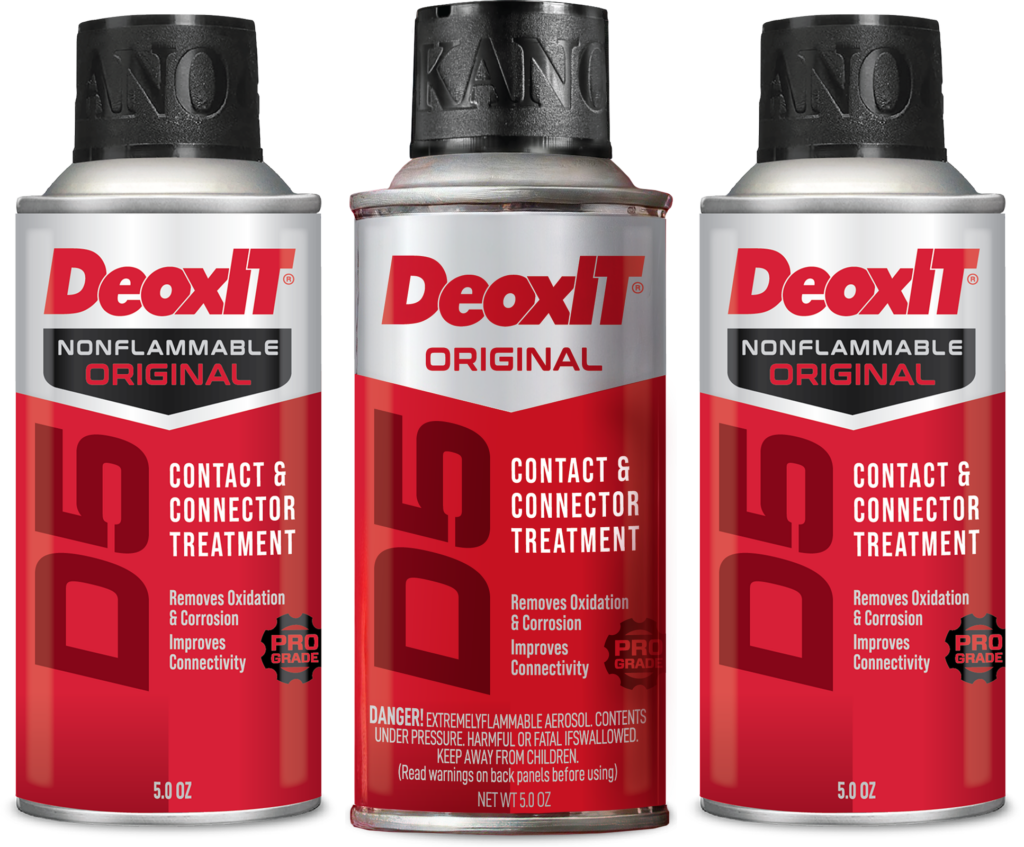
Material: Non-ferrous metals (gold, copper, bronze) call for DeoxIT® Gold. Ferrous metals (nickel, tin, silver, steel) call for DeoxIT® Original, DeoxIT®, or both.
Severity: Very severe corrosion should follow the Outdoor & Severe Applications guidance. Severe corrosion, ferrous or non-ferrous, starts with Original to clean the surface, repeated over several days if needed, then follows the material guidance above. Minor oxidation on non-ferrous metals responds to Gold alone, though it may take a few passes. Minor oxidation on ferrous metals responds to Original, followed by Shield in humid, corrosive, or high-salt environments.
Equipment Condition: Deteriorated or aged contact surfaces should avoid solvent-based applicators without testing first, since solvents can flake or displace compromised metal. 100% DeoxIT® solutions are the safer starting point.
Accessibility: Easy-to-reach surfaces respond well to non-aerosol applicators, applied sparingly and wiped clean. Difficult access calls for an aerosol spray or needle dispenser.
Sensitive Materials: Non-aerosol applicators are the safer default around sensitive components, particularly aged ones. Where aerosols or solvents are being considered, test on a single part first and wait several days before proceeding to the rest.
Flammability: Where flammability is a concern, use a non-flammable spray or a 100% solution. Solution percentage and flammability are both listed on the product’s description tab.
Outdoor Connections
Electrical and electronic connections in severe environments, such as high humidity, corrosive air, salt exposure, or pollution, face two distinct issues: oxidation or corrosion on the contact surfaces themselves, and physical wear on the mechanical elements that hold the connection together, lik...
Connection Type: Determine whether the connection is purely electrical, purely mechanical, or electrical with mechanical movement, since that governs which product family applies.
Exposure Level: Semi-protected connections, such as those inside an irrigation control box, call for DeoxIT® Original and/or DeoxIT® Shield. Fully exposed connections, such as outdoor speaker connectors or boat instrument connectors, call for Original and/or Shield, L260D, or SM22D.
Voltage & Amperage: Connections at or below 115V and 5 amps call for Original. Connections above either threshold typically call for L260D or SM22D Shield greases.
Controls
Product selection for pots, faders, conductive plastics, and carbon-based controls starts with the control type and what it's made of, since rotary and linear controls tend to use different combinations of conductive material.
Control Type: Determine whether this is a rotary potentiometer or a linear fader, since that governs the likely material makeup.
Materials: Rotary pots most often combine metal components with some carbon. Linear pots and faders are mainly carbon, though some also include metal rails.
Equipment Age: Newer equipment, under 10 years old, can typically use a spray with solvents. On pots or faders with both carbon and metal, use D5S-6 or DN5S-6N: spray one or two short bursts, rotate the control ten times, then apply one more short burst. Older equipment should use D100S-2, a 100% solution with no solvents, applied the same way. Linear pots and faders made only of carbon or conductive plastics call for DeoxIT® Fader F5S-6 on newer equipment, or DeoxIT® Fader F100S-L2, a 100% solution, on older equipment, both applied with the same spray-rotate-spray technique.
Tactile Feel: If more resistance or feel is needed after treatment, apply DeoxIT® FaderGrease.
Tips
Sensitive Materials: Avoid spraying directly onto porous surfaces like a guitar’s pick-guard or wood finish. If a spray is necessary, choose one without solvents, such as D100S-2, G100S-2, or F100S-L2. Wipe up any overspray on sensitive materials right away. To treat an output jack, spray or wipe the product onto the cable’s plug, then insert it. The DeoxIT will transfer to the socket on contact. Guitar strings should be treated separately with DeoxIT AxeWipes.
Spraying In Tight Spaces: Use the extension tube included with the spray can. Perfect-Straw actuators, the yellow straw, support a range of attachments for hard-to-reach areas. Spray cans with the L-M-H valve use the red straw instead.
| I Need To... | Recommended Product |
|---|---|
 Remove oxidation and restore conductivity
|
DeoxIT® Original
Cleans and rejuvenates electrical connections |
 Clean and protect gold and other noble metal plated contacts
|
DeoxIT® Gold
Designed specifically for gold and noble metal surfaces |
 Clean and lubricate faders and potentiometers
|
DeoxIT® Fader
Controls fader noise in audio mixers and potentiometers |
 Protect metal surfaces and connections from corrosion
|
DeoxIT® Shield
Long-lasting protection for metal surfaces and connections |
Flex Panel Here Lorem Ipsum Dolor Amet
Nulla vitae elit libero, a pharetra augue. Etiam porta sem malesuada magna mollis euismod. Lorem ipsum dolor sit amet, consectetur adipiscing elit. Donec ullamcorper nulla non metus auctor fringilla.
Lorem Ipsum Dolor
- Cras justo odio, dapibus
- Vestibulum id ligula porta felis euismod semper.
- Integer posuere erat a ante venenatis dapibus posuere velit aliquet.


